Resilient Stage 4 colon cancer patient discovers surgery option close to home
Gayle Knoop doesn’t post about her cancer on social media, so most people didn’t even know she had been diagnosed with Stage 4 colon cancer with liver metastases in October 2024, or that the cancer had returned after nine months, or that she was preparing for Christmas 2025 to be her last with her family.
She was trying to stay upbeat.
“I’m at home over the holidays thinking this is probably my last Christmas with my family,” said Knoop, who has a husband, 22-year-old daughter, three dogs, and an older brother. “It was miserable.”
After treatment, she had been cancer-free for nine months, but the cancer returned in her liver. Her hometown doctor told her the clinical team had met about her case, and she wasn’t a candidate for surgery. She could do Y90 radiation, which she did not want to do.
Knoop said she finally “dug deep” and started going down all the rabbit holes and doing her research.
It was different than the pressures she felt growing up playing volleyball, softball and basketball. This one was medical, and she felt hopeless, but she had a hunch there could be something out there for her.
“I want to be here for my daughter. I want to see her graduate from medical school. I want to see her get married,” she said. “And I’m like, OK, get up off your ***, start digging. You’ve done it before. You can do it again. And it led me to Vanderbilt. And, to me, that was my answered prayer for God to put the right people in my path, and he did.”
A better option than expected
With a little sleuthing and perseverance, she found something online with good reviews about Sekhar Padmanabhan, MD, just two-and-a-half hours away from her home in Louisville, Kentucky, at Vanderbilt-Ingram Cancer Center in Nashville. And it was in network for her insurance.
She came to Vanderbilt-Ingram in search of the histotripsy surgery she read about online, but Padmanabhan instead performed robotic-assisted laparoscopic surgery on Knoop to remove the left lobe of her liver and two tumors from the right lobe.
“The patient sheet just said she was there to discuss histotripsy, which she had read about online. Histotripsy was not what she needed; we had a better option than that,” said Padmanabhan, Assistant Professor of Surgery, who came to Vanderbilt-Ingram in 2021 to help build the robotic liver and pancreas program.
“Obviously she was shocked when I said, ‘I think we can remove these tumors and potentially put you on a path for a curative-intent option,’” he said.
Prior to 2022, there had not been a robotic liver resection done at Vanderbilt Health or in Nashville. There have now been more than 100 robotic liver resections at Vanderbilt Health.
A word no one says with Stage 4 cancer
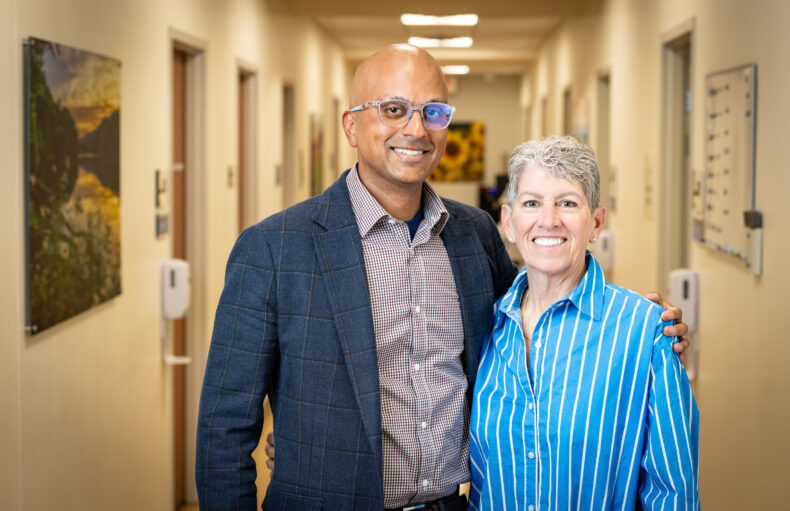
Padmanabhan said Knoop’s story amplifies the importance of educating not only community oncologists but also patients about new therapies and technologies available to them.
“Gayle has a certain level of grit and is someone who will not be a defeatist … would not take ‘no’ for an answer. I am thankful that mentality is a part of her, because otherwise she wouldn’t have ended up here,” he said.
“As I was looking through her labs and her scans and her history, in my mind, I was saying, ‘What are we missing here? Why are we not operating on her? She has a chance at a curative option, and why are we not offering that?’”
Knoop required a couple of visits to Vanderbilt-Ingram to repeat scans, make sure her blood work looked good, and make sure her liver was healthy before she could have the robotic-assisted liver resection.
“He offered me a 20% chance of a cure. You know, nobody ever says ‘cure’ with Stage 4 cancer, and he offered me a 20% chance at a cure,” she said. “And, for the first time, I had hope, and it wasn’t false hope. I had hope, and I had confidence in the people that I was dealing with.”
The surgery also allowed her to go back to Louisville the next day instead of a more invasive surgery that would have included five days in an intensive care unit and a roughly 10-day hospital stay.
“These successes need to be shared with the world”
Padmanabhan said he saw her in the clinic two to three weeks after her surgery, and she looked great and was back to her usual day-to-day activities. At a later follow-up with Justin Lo, MD, PhD, Assistant Professor of Medicine, her scans and blood work continued to look great.
“When an institution and the people who make it up are this special, it deserves to be recognized,” Knoop said. “Tunnel vision is inevitable when this is your day-to-day life, but I truly believe Dr. Padmanabhan and his team at Vanderbilt-Ingram saved my life and could save the life of so many others. It is imperative that these successes are shared with the world.
“I was more than a patient or cancer case. I was a wife, mom and sister who needed his incredible knowledge of advanced technology and his surgical skills to spend more time in these roles with my family,” she said.
Padmanabhan said Vanderbilt-Ingram is “pushing the envelope” with new technologies like histotripsy and new programs like robotic liver surgery and robotic pancreas surgery, serving patients not only from Tennessee, but also parts of Kentucky, Alabama and Georgia.
“Gayle’s story is obviously unique to her and very personal for her but, unfortunately, that is the story that we hear a lot, especially in this area,” he said.
“Folks don’t necessarily have access to that care close to their home, so I would encourage people to see if there are newer drugs, treatments, surgeries, therapies and technologies that we can offer you that could extend your life, perhaps cure you in certain instances, but also ensure that we do all those things while maintaining your quality of life.”
The post Resilient Stage 4 colon cancer patient discovers surgery option close to home appeared first on Vanderbilt Health News.